


Dear Great Lakes Wealth Clients, Families & Friends:
Election news dominated headlines through July and culminated in President Joe Biden declining to seek a second term, instead endorsing Vice President Kamala Harris as the Democratic Party’s candidate. The markets don’t particularly like uncertainty, but the turbulence that followed this commotion is not likely to linger as more fundamental market forces play out.
The market’s expectations have been on a rollercoaster regarding the Federal Reserve (Fed) cutting interest rates this year, but with inflation receding and consumer spending beginning to slow, lower rates seem finally in sight. This has bolstered small-cap stocks, which had their best monthly performance in July relative to large-cap stocks since December 2000*.
Historically, small caps outperform in anticipation of and following a first rate cut, and this rally is supported by improvements to corporate earnings. Earnings are on track to rise 10% year over year, turning in the best quarter since the fourth quarter of 2021. Real estate and utilities were the best performing sectors. Tech-related sectors underperformed.
Bond yields were lower across the board, led by shorter-term securities, as markets priced in the likelihood of a rate cut.
Employment remained strong in June, with the establishment employment survey showing jobs increasing by 206,000, but the unemployment rate – which comes from the household survey – inched up to 4.1% from 4.0%.
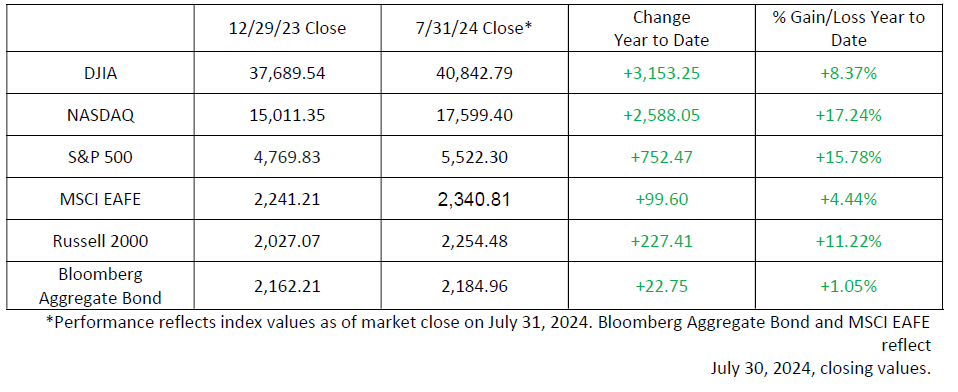
We’ll dig into the details below, but first we’ll look at the numbers year-to-date:
U.S. economy remains stable
The Consumer Price Index increased less than expected in April, signaling a slowdown in inflation, and although employment growth slowed considerably in May, it remained robust compared to the historical average, growing by 175,000 new jobs. Private jobs posted an increase of 167,000. Mortgage rates continue to weigh on housing starts, existing home sales and new home sales, which were all weaker than expected in April.
Treasurys balance on Fed action
After a strong start to the month, supported by a softer April inflation report, Treasury yields resumed
their upward march as better than expected economic activity, hawkish rhetoric from the Fed and softer
demand weighed on sentiment. The market is in a wait and see mode and the 10-year Treasury yield
may remain within a tight range until something causes it to move.
Equities trending up, but volatility ahead
With the S&P 500 up 50% over the last 400 days, consolidation is not unexpected, especially considering
investor uncertainty on the pace of disinflation and the timeline of Fed actions. The path to inflation
normalization is unlikely to be smooth, so while equities may be in an uptrend, some fluctuations along
the way are possible.
Biden administration raises Chinese tariffs
Trade remained a key issue in May, with the Biden administration unveiling tariff hikes on around $18
billion of Chinese imports across strategic tech sectors including electric vehicles, batteries, solar
products, semiconductors and critical minerals. The administration also maintained existing duties on
around $300 billion of Chinese goods.
Oil prices cool down, but risk remains
Spiking oil prices in April, bolstered by fears of all-out war between Iran and Israel, cooled off in May,
just as the summer driving season began. Now the oil market is less focused on the situation in the
Middle East, but the Russia-Ukraine war still presents physical risks to the oil supply as Ukrainian drones
continued attacking Russian oil refineries, disrupting the processing of fuels in the world’s largest oilproducing
country.
Lower rates likely in euro zone and Canada, less so in U.K.
The European Central Bank seems poised to make a rate cut in response to the slow-paced economic
recovery, following its Swiss and Swedish counterparts. Canada’s inflation rate is now within the Bank of
Canada’s target range, so the central bank may lower interest rates to bolster the shaky Canadian
economy. Inflation in the U.K., although falling, remains too high for most rate-setters, suggesting the
Bank of England will not lower rates immediately, to the chagrin of the Conservative government ahead
of a July 4 general election.
May’s market performance elicits optimism, but volatility is always a possibility – especially with the
continued uncertainty regarding inflation, interest rates and international conflicts, including:
The bottom line:
- By the end of 2024, we expect a slowing of economic growth in the United States, but not a recession.
- We expect U.S. equities to be volatile in the short-term, but to be positive in 2024. Do you remember the old saying, “Sell in May and Buy back after Labor Day"?
- We believe that interest rates have peaked and may fall in the second half of 2024.
- Cash is king, and Bonds are back. We would add traditional fixed income, particularly money markets and short dated bonds, for safety and stability in 2024.
- We recommend investors to continue to consider an overweight of alternative investments, including private equity and debt.
- Gold has broken through $2,300. We expect to see continued higher prices, and have raised our target to $2,500 per ounce, in 2024.
- Cryptocurrencies have soared in 2024. We expect continued volatility.
- Depending on your timeframe, current investment strategies should be based on what’s happening “Now,” “Next,” and “Later.”
- We currently have a “Buy” on 11 of our 12 strategies. Which strategy is right for you? That just depends on your risk tolerance, ultimate objective, etc.
We are happy to discuss this with you. - Our current approach continues to be discipline and patience when both buying and selling. Volatility will continue to create opportunities for 2024.
We’re glad to be able to bring you these updates and hope you find them helpful. Your financial goals
are always top of mind, so please don’t hesitate to reach out regarding any questions or concerns you
may have.
Sincerely,
Your Investment Team at Great Lakes Wealth
Investing involves risk, and investors may incur a profit or a loss. There is no assurance the trends mentioned will continue or
that the forecasts discussed will be realized. Past performance may not be indicative of future results. Economic and market
conditions are subject to change. The Dow Jones Industrial Average is an unmanaged index of 30 widely held stocks. The
NASDAQ Composite Index is an unmanaged index of all common stocks listed on the NASDAQ National Stock Market. The S&P
500 is an unmanaged index of 500 widely held stocks. The MSCI EAFE (Europe, Australasia and Far East) index is an unmanaged
index that is generally considered representative of the international stock market. The Russell 2000 is an unmanaged index of
small-cap securities. The Bloomberg Barclays US Aggregate Bond Index is a broad-based flagship benchmark that measures the
investment grade, U.S. dollar-denominated, fixed-rate taxable bond market. An investment cannot be made in these indexes.
The performance mentioned does not include fees and charges, which would reduce an investor’s returns. Investing in the
energy sector involves special risks, including the potential adverse effects of state and federal regulation, and may not be
suitable for all investors. A credit rating of a security is not a recommendation to buy, sell or hold the security and may be
subject to review, revision, suspension, reduction or withdrawal at any time by the assigning Rating Agency. Bond prices and
yields are subject to change based upon market conditions and availability. If bonds are sold prior to maturity, you may receive
more or less than your initial investment. Income from municipal bonds is not subject to federal income taxation; however, it
may be subject to state and local taxes and, for certain investors, to the alternative minimum tax. Income from taxable
municipal bonds is subject to federal income taxation, and it may be subject to state and local taxes. Investing in commodities
is generally considered speculative because of the significant potential for investment loss. Their markets are likely to be
volatile and there may be sharp price fluctuations even during periods when prices overall are rising. International investing
involves special risks, including currency fluctuations, differing financial accounting standards, and possible political and
economic volatility. The companies engaged in the communications and technology industries are subject to fierce competition
and their products and services may be subject to rapid obsolescence. The Consumer Price Index is a measure of inflation
compiled by the US Bureau of Labor Studies. The Leading Economic Index (LEI) provides an early indication of significant turning
points in the business cycle and where the economy is heading in the near term.